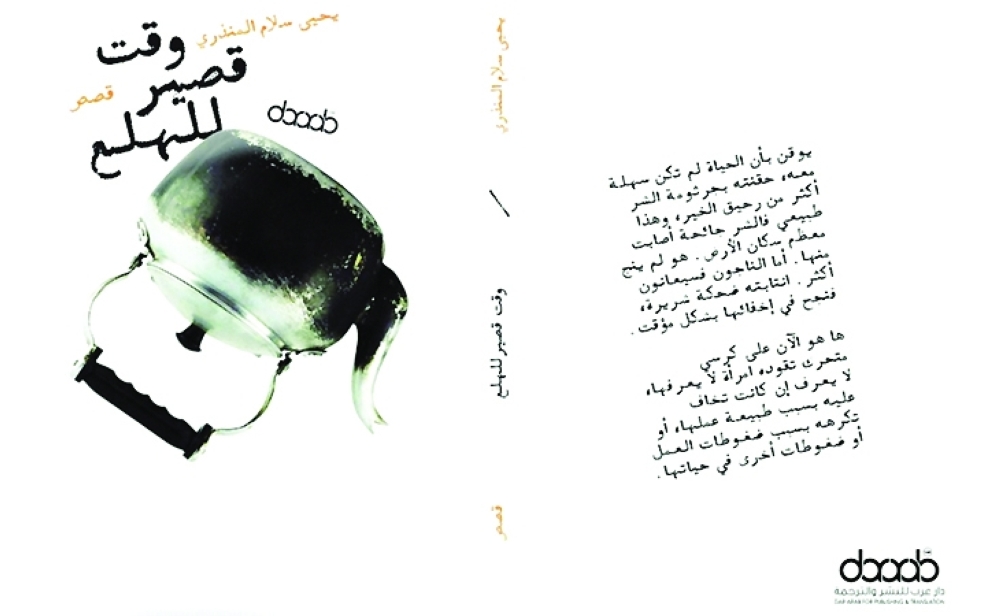





In Yahya bin Salam al Mundhiri’s three stories collected under the title A Brief Moment of Panic, published by Arab Publishing House, fear takes many forms: fear of loss, loneliness, exile, poverty and illness.
Al Mundhiri’s fascination with fear is not new. In his collection A Lonely House in the Desert (2002), he wrote about migrant workers and their experiences of displacement. In his new book, he returns to that world, as though the earlier stories had left something unfinished. He revisits characters who once appeared only from the outside and now allows us to hear more of what they carried within them.
This time, migrant workers are not simply people labouring amid what might be called a “forest of concrete”. They are part of the houses we live in, carrying with them dreams, memories and private wounds. Mary, in the story Boxes of Coloured Surprises, is one example.
In A Brief Moment of Panic, Al Mundhiri seems to become at once reader, writer and imagined translator of the second part of his earlier collection, Planters of the Concrete Forest. This is especially clear in the story Boiling Tea, which stands at the centre of the book and creates a direct bridge between the old collection and the new.
The connection becomes clearer when we compare it with A Letter from That Country, a story from A Lonely House in the Desert. In the earlier story, a letter is taken away by two brothers. Years later, in Boiling Tea, that missing letter appears to be symbolically replaced by something richer and more open: My Sister Hasina’s Gif

Boiling Tea is divided into three parts: My Sister Hasina’s Gift, The Concrete Book and The Hunter of Female Workers.
In the first section, Hasina sends her brother Mohammed bin Izz Al Din, a migrant worker in Oman, a collection of Omani stories translated from Arabic into English. The book is titled A Lonely House in the Desert. This immediately raises a question: will the brother actually read his sister’s gift?
The answer is crucial. Through reading, Mohammed is brought closer to his own reality. As one of the workers described in the book, he begins to see himself and others like him through the eyes of an Omani writer. He can therefore ask deeper questions: How do Omanis see him? What does it mean to spend fifteen years in a foreign country? How does a person endure such distance from home?
Reading gradually transforms the migrant worker into a critic and then into a writer. He even describes one of the stories in A Lonely House in the Desert as “boring”. More importantly, the book itself becomes his diary. On twenty-nine blank pages, he records twenty-two entries between June 20 and December 10.
Writing becomes his only private refuge after exhausting working days. Through it, he remembers his sister, recalls his parents and returns inward to himself. Literature becomes memory, confession, contemplation and release. For a man living far from home, writing offers a space in which loneliness can be named and endured.
This is perhaps where Al Mundhiri’s story is at its most humane. A simple migrant worker becomes both reader and writer, and literature becomes the means through which he understands himself. The diary, the most intimate of literary forms, gives voice to someone whose life might otherwise remain unseen.
The second section, The Concrete Book, complicates this relationship between reading and writing. The original story collection and the worker’s handwritten diary become, in effect, one book. The translated stories exist beside his personal notes, written on the empty pages. The reader therefore encounters two voices: the original author’s and the migrant worker’s.
The third section, The Hunter of Female Workers, explains how these private writings reached us. Here, Al Mundhiri introduces the imagined figure of the translator and creates a literary device that allows the worker’s diary to become part of the published story.
This strategy blurs the boundaries between author, reader, translator and character. Al Mundhiri himself becomes part of the fiction without appearing directly within it. He creates the illusion that Boiling Tea is a story written by two people: the known author and the imagined migrant worker.
The result is a sophisticated game of storytelling built upon earlier texts, missing letters, translated books and hidden diaries. Yet beneath these devices lies a simple and powerful idea: literature can give people a second life on the page.
The story ends with the narrator saying that the tale came to him “like a gentle wind”, disturbed him for a time, and then ended. But one question remains: how successfully do these literary devices connect the real author, the imagined writer and the translator within a single convincing narrative?
That question may be precisely what makes Boiling Tea worth returning to.
Translated by Badr al Dhafari. This is an adapted translation of the original Arabic article published in the print edition of Nizwa Magazine on 29 April 2023.
Oman Observer is now on the WhatsApp channel. Click here